Top Cities by Business Climate Score: A Definitive Economic Analysis 2026


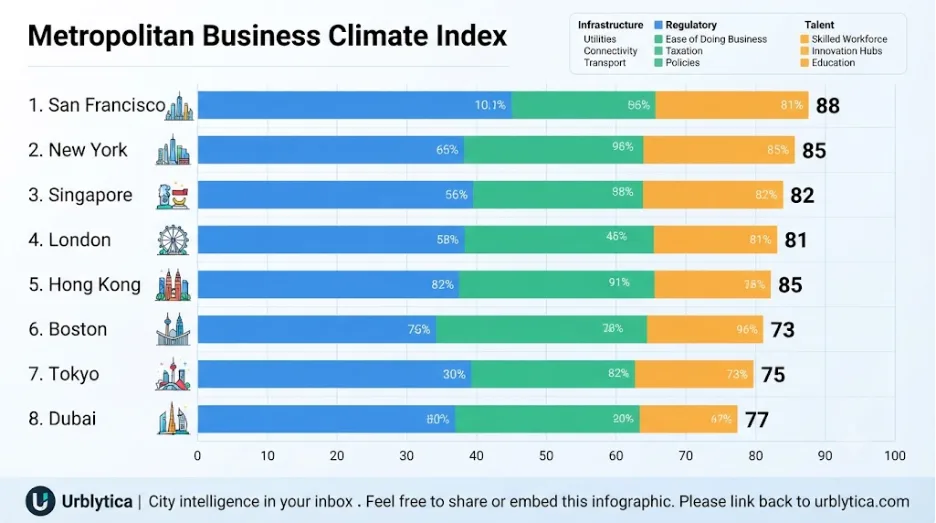
The landscape of American entrepreneurship is undergoing a profound transformation as the geographic distribution of commercial opportunity realigns with modern infrastructure and labor mobility. Selecting a location for a new enterprise is no longer a simple exercise of finding low tax rates or minimal regulation. Modern leadership teams are evaluating locations based on a holistic business climate score that encompasses regulatory stability, access to specialized labor, and the integration of research ecosystems. As firms prioritize operational resilience, the data suggests that secondary markets are capturing significant capital flows, effectively challenging the historical dominance of traditional financial hubs.
This comprehensive 2026 economic analysis evaluates global metropolitan areas by their overall business climate score, assessing tax structures, regulatory efficiency, talent availability, and operational overhead. By analyzing critical commercial indicators and institutional capital flows, the report identifies the top urban hubs fostering the most business-friendly environments for corporate expansion and strategic investment.
The Evolution of Commercial Ecosystem
The concept of a business climate score has evolved significantly over the last decade. It has transitioned from a metric focused primarily on tax burdens to a multidimensional analysis of institutional readiness. When executives evaluate where to start a business in the United States, they must weigh the administrative friction of a state against the longterm potential of the local workforce. High scores are currently attributed to regions that provide a stable compliance calendar, allowing firms to focus on core operational scaling rather than navigating the complexities of local zoning and environmental bureaucracy.
Data hygiene and administrative accuracy have become the silent determinants of business success. Companies that maintain a rigorous approach to business formation are consistently better positioned to secure private financing and government grants. Administrative failure, such as missing an annual report filing, creates unnecessary risk that can derail even the most promising venture. In modern industrial and service landscapes, operational clarity is a competitive advantage that directly influences a firm's ability to attract and retain elite talent.
Regional Dynamics and Economic Performance
When we examine the strongest economic growth in the nation, a clear pattern of regional clustering emerges. The Sunbelt remains the primary engine of demographic and industrial expansion, with cities leveraging their geographic and regulatory advantages to attract multibilliondollar investments. These regions are succeeding because they have mastered the integration of private industry, public sector investment, and academic pipelines. The following table illustrates the performance indicators for cities consistently scoring high in current business climate evaluations.
|
City |
Growth Index |
Infrastructure Rating |
Regulatory Environment |
Talent Pipeline |
|
Dallas |
9.4 |
Excellent |
ProBusiness |
High |
|
Austin |
9.2 |
Strong |
Favorable |
Very High |
|
Charlotte |
8.9 |
Robust |
Balanced |
Moderate |
|
Nashville |
8.7 |
Stable |
Competitive |
High |
|
Phoenix |
8.5 |
Growing |
Moderate |
High |
|
Raleigh |
8.4 |
Strong |
Balanced |
High |
|
Tampa |
8.2 |
Developing |
Favorable |
Moderate |
|
Atlanta |
8.1 |
Mature |
Competitive |
High |
Strategic Site Selection and Capital Intensity
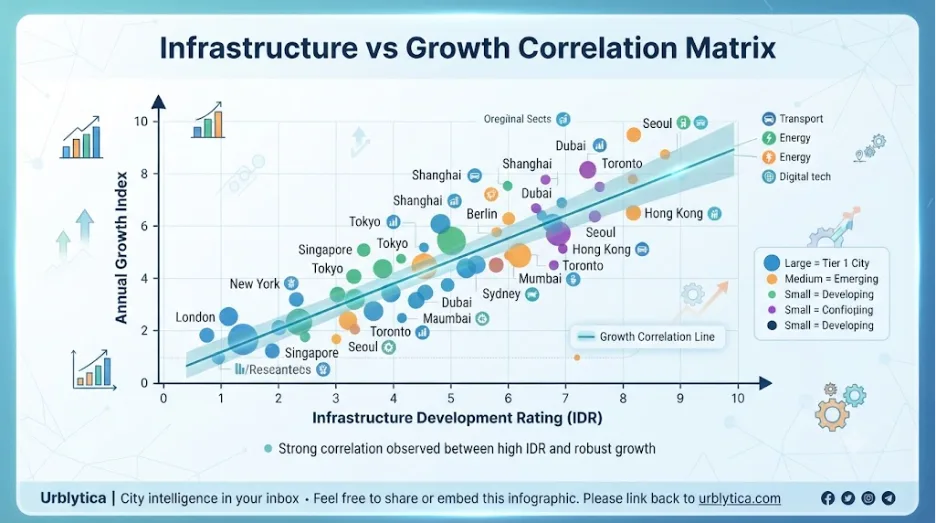
Selecting a site for longterm operations is a decision with a multidecade horizon. Leaders must account for demographic trends, labor costs, and longterm energy infrastructure stability. Firms that engage in a rigorous economic analysis prior to site selection drastically reduce their exposure to operational risk. The process of evaluating a city should be datadriven, looking beyond immediate tax breaks to assess the longterm viability of the local labor market and the city's commitment to technical training pipelines.
For those looking to buy a business in a new metropolitan area, the complexity of due diligence has increased. It is not sufficient to evaluate the financial health of the target enterprise; one must also model the external economic pressures of the city itself. Firms must monitor their breakeven point constantly as they account for varying utility costs and different labor market pressures across state lines. The key to maintaining solvency is to ensure that the debttoequity ratio remains stable while investing in assets that depreciate over long periods.
Operational Excellence and Administrative Scaling
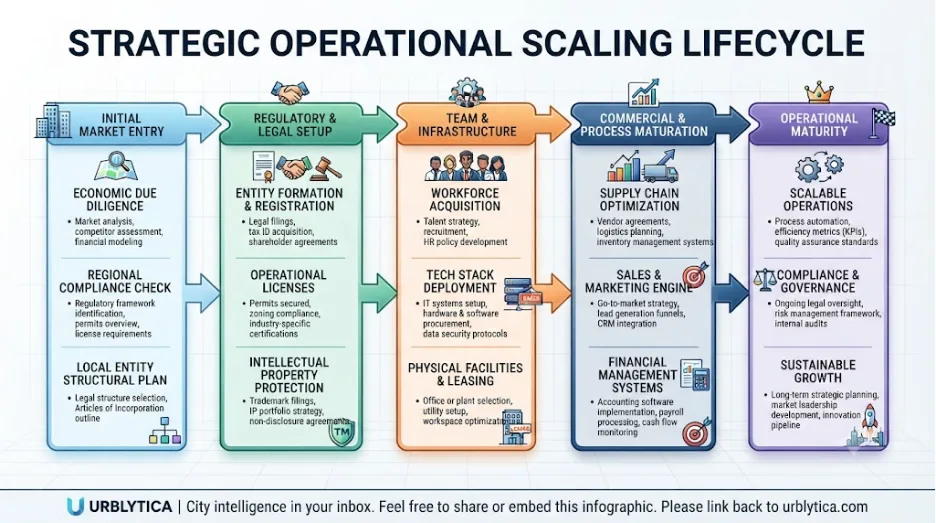
As organizations scale their operations across state lines, the administrative burden of maintaining compliance becomes a significant operational cost. Firms that prioritize their business compliance checklist are consistently better positioned to secure private financing and government grants. Maintaining operational clarity requires discipline, often supported by tools that help with freelance tax and operational reporting.
The integration of modern digital technology is a cornerstone of sustainable operational growth. With the administrative burden of daily work rising due to complex billing and regulatory requirements, institutions are turning to sophisticated digital solutions to optimize human output. By leveraging these technologies, administrators can accurately identify systemic bottlenecks in their daily workflows and implement software solutions that drastically reduce the time spent on tedious documentation. This digital evolution is not merely about reducing overhead expenses; it is fundamentally about retention of key personnel.
When evaluating the viability of an expansion, one must consider the regulatory framework. Whether you are seeking to start a business or planning to buy a business in a specific state, the entity types you choose to set the foundation for your tax obligations and liability. Firms should utilize resources such as the comprehensive business guides available to navigate these complexities. Establishing a solid foundation involves understanding the entity types that best serve your scaling goals, whether that is a standard LLC or a more complex corporation.
The importance of data integrity cannot be overstated. As firms expand, the risk of administrative friction increases. Utilizing a bulk address cleaner can ensure that your customer and payroll data remainaccurate across all branches, preventing costly errors. Similarly, managing your entity's status is vital. Missing aannual report filing can led to a loss of good standing, which is often a red flag for lenders and investors. Maintaining a strict compliance calendar is the hallmark of a scaling firm that intends to dominate its market.
Financial Modeling for LongTerm Growth
Sustainable growth requires an obsession with operational margins. Management must perform regular audits to ensure that input costs, such as energy, logistics, and labor, remain within projected ranges. For manufacturing or service firms, inventory turnover and labor productivity are the primary KPIs that drive overall capital recovery. By focusing on these metrics, leadership can pivot quickly when market conditions fluctuate.
The following table serves as a strategic roadmap for firms scaling in highclimate score cities, detailing how capital intensity influences operational success.
|
Metric |
Performance Goal |
Risk Management Factor |
Significance for Scaling |
|
Breakeven Point |
Under 24 Months |
Fixed Cost Management |
Essential for Capital Recovery |
|
Operating Margin |
Above 15 Percent |
Input Cost Volatility |
Measures Operational Efficiency |
|
DebttoEquity Ratio |
Below 1.0 |
Interest Rate Fluctuations |
Ensures Longterm Solvency |
|
Return on Assets |
Above 10 Percent |
Asset Depreciation |
Validates Capital Investment |
|
Labor Productivity |
5 Percent Annual Growth |
Skill Shortages |
Drives Scalability |
|
Supply Chain Lead |
Under 30 Days |
Geopolitical Instability |
Protects Output Continuity |
|
Inventory Turnover |
Over 6 Times |
Market Fluctuations |
Maximizes Liquid Cash Flow |
|
R&D Investment |
Over 5 Percent |
Stagnation Risk |
Fuels Future Innovation |
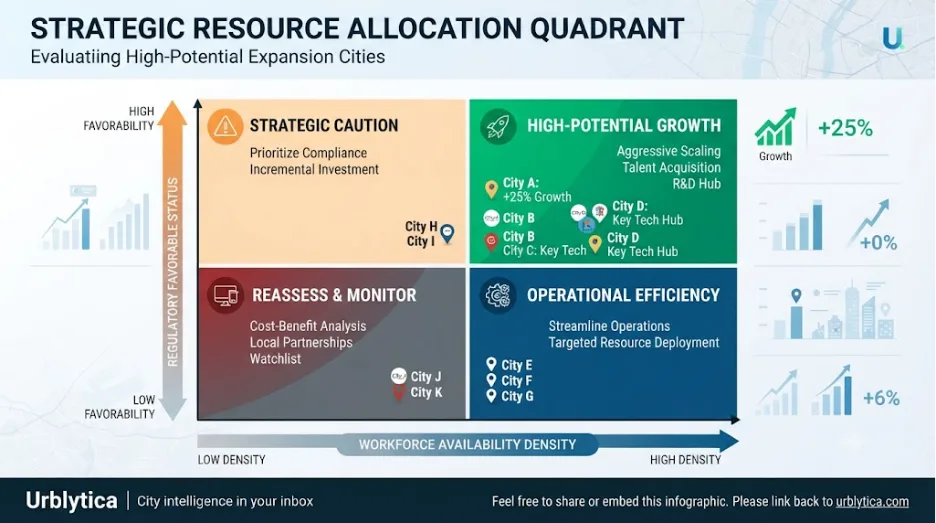
As you scale, the choice of location remains paramount. The most successful cities provide more than just favorable tax rates; they offer a deep ecosystem of suppliers and talent. For those who want to analyze cities based on objective data, reviewing the rankings and categories provided by experts is a vital step in your site selection process. Furthermore, understanding the local cost of living and its impact on your employees is essential, especially when hiring talent from across the country. Using a cost of living calculator can help you tailor your compensation packages to be competitive without eroding your operating margins.
Future Trends in Urban Business Development
The coming decade will be defined by further hybridization of digital workflows and administrative automation. As artificial intelligence becomes more deeply integrated into site selection and resource management, the nature of business expansion will shift toward more precise, databacked models. We expect to see a substantial increase in demand for hybrid metropolitan areas that possess both strong technical digital aptitude and deep physical logistics infrastructure.
The trend of exurban realignment, discussed in studies about top 100 fastest growing cities, suggests that the future of economic growth will be significantly more decentralized. Smaller, agile boutique cities that cater specifically to local demographic clusters are likely to experience much faster growth than massive, centralized financial hubs. This structural shift creates a unique opportunity for nimble entrepreneurial firms to successfully fill critical gaps in underserved suburban and exurban markets across the country.
When analyzing regional competition, such as the nashville vs charlotte report, it becomes evident that the business climate is a critical strategic asset. Cities that successfully lower their local cost of living are demonstrably more successful at attracting and retaining talent, which remains a massive differentiator for firms aiming to keep operational costs under tight control. The intricate synergy between regional workforce supply and actual commercial demand remains the most delicate aspect of successfully managing a modern enterprise in a volatile economic climate.
Frequently Asked Questions
1. What factors contribute most to a high business climate score?
A high score is determined by regulatory stability, infrastructure robustness, talent availability, and the transparency of the tax and compliance environment.
2. Why are secondary cities often performing better than major metropolises?
Secondary cities often offer lower operational costs, less bureaucratic friction, and significant room for demographic and industrial growth.
3. How does local regulation impact the decision to start a business?
Favorable local regulations reduce the administrative burden of entry, allow for faster scaling, and provide a predictable landscape for longterm investments.
4. Is tax incentive the most important factor in site selection?
No, while tax incentives are relevant, executives prioritize longterm infrastructure stability, skilled talent pipelines, and research ecosystems.
5. How can firms maintain good standing across multiple states?
Firms should utilize a dedicated compliance calendar and ensure that all annual filings and registered agent requirements are meticulously managed.
6. What is the role of technology in modern business climate assessment?
Technology allows for realtime analysis of demographic shifts, labor market trends, and operational costs, enabling datadriven site selection.
7. How do firms calculate the return on investment for a new location?
Firms perform thorough breakeven analyses and project asset depreciation over long periods to validate capital investment against potential local revenue.
8. What is the impact of workforce training on business climate?
Cities with strong partnerships between industry and vocational institutions create a steady pipeline for skilled workers, which reduces hiring risks.
9. Why is data hygiene essential for scaling firms?
Inaccurate data in payroll, taxes, or compliance filings can cause administrative friction and legal issues that severely hinder rapid expansion.
10. How does the current demographic shift toward the Sunbelt affect business?
The influx of population to the Sunbelt increases consumer demand and provides a larger, younger labor pool, driving sustained economic growth in those regions.