


Dallas vs Austin Demographics: 2026 Comprehensive Analysis


The state of Texas stands as a global economic powerhouse, with the DallasFort Worth metroplex and the Austin metropolitan area serving as its twin engines of growth. As we navigate through 2026, the contrast between these two regions has become more pronounced, offering distinct value propositions for residents, businesses, and investors. While Dallas anchors itself as a massive, diversified corporate headquarters for established industry giants, Austin continues to refine its identity as a highvelocity innovation hub driven by tech and creative industries. Understanding the nuances of their demographic and economic trajectories is essential for anyone looking to capitalize on the Texas growth story. This analysis explores the core drivers of these two cities, their demographic shifts, and their future outlooks.
The Demographic Landscape of Texas
The demographic profiles of Dallas and Austin are shaped by entirely different growth philosophies. Dallas acts as a central node for a massive, sprawling metroplex that draws from a wide variety of domestic and international migration patterns. Austin, conversely, is defined by an influx of highly educated, techfocused professionals who are moving to the city for lifestyle and employment opportunities in software, hardware, and biotechnology. When analyzing localized consumer demographic profiles, one can see that Dallas offers a more balanced crosssection of age groups and household types, whereas Austin displays a more concentrated demographic skew toward younger, collegeeducated individuals.
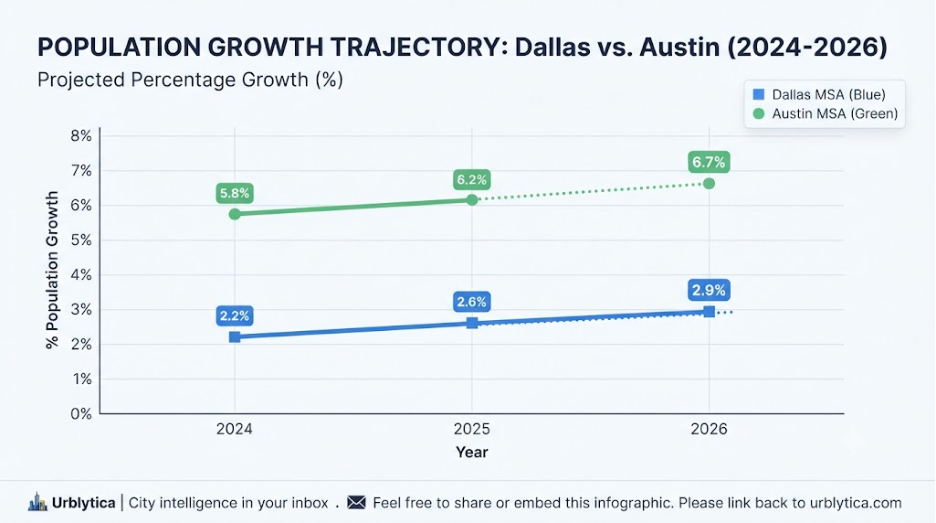
For those interested in the broader picture of population trends, observing regional market viability data shows that Dallas provides a stability that few other American cities can match. Its population base is deep and expansive, anchored by decades of suburban development and established residential communities. Austin has experienced a more rapid, compressed growth rate, which has resulted in a more dynamic but also more volatile demographic shift.
Investors often use a population growth calculator to better understand the longterm sustainability of these regions. In Dallas, the population growth is tied to the expansion of mature industries that require a steady, predictable supply of labor. In Austin, the growth is tied to the venture capital and innovation cycle, which can be more sensitive to shifts in the global tech economy.
|
Demographic Metric |
Dallas MSA |
Austin MSA |
Growth Driver |
|
Median Household Income |
84,500 |
92,200 |
Tech vs Services |
|
Median Age |
36.4 |
34.1 |
Diverse vs Youth |
|
Population Growth 20242026 |
1.9% |
2.6% |
Migration |
|
Education Level (Bachelors+) |
41% |
53% |
Workforce Needs |
|
Foreign Born Population |
24% |
18% |
Trade Diversity |
|
Housing Occupancy Rate |
94.2% |
93.1% |
Supply Demand |
|
Average Household Size |
2.8 |
2.5 |
Family vs Single |
|
Rent to Income Ratio |
29% |
34% |
Affordability |
The data above illustrates why investors often seek citylevel economic data profiles to make informed decisions. Dallas has successfully scaled its population without sacrificing the diversity of its age cohorts, which is a major advantage for businesses that require a multigenerational workforce. Austin has leveraged its appeal to younger demographics to build a talent pipeline that is specifically tailored to the requirements of the 21stcentury tech economy.
Economic Drivers and Industrial Diversification
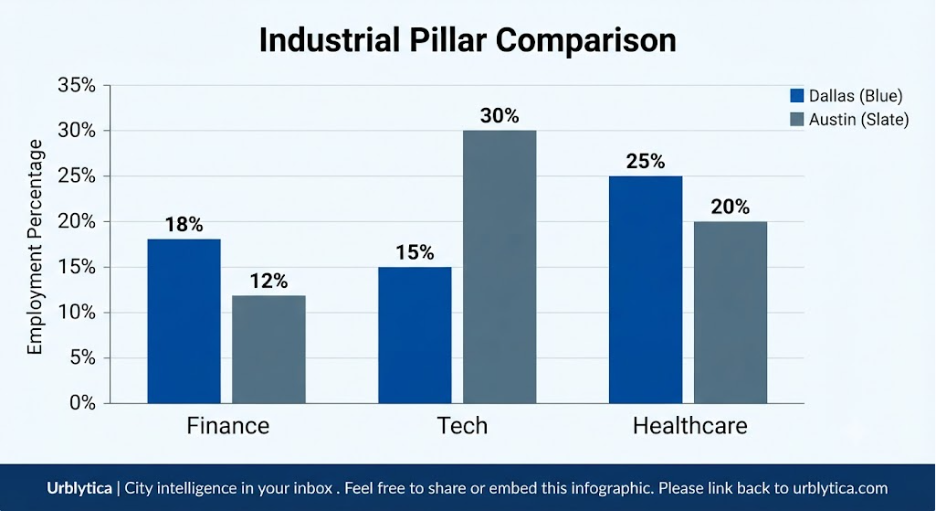
The economic structure of these two cities represents a classic study in divergence. Dallas has built a monumental infrastructure for finance, telecommunications, insurance, and logistics. It is the premier choice for organizations that need to start a business and want immediate access to a seasoned, largescale supply chain. The corporate presence in Dallas is not just about quantity; it is about the integration of multiple sectors that keep the regional economy buffered against the ups and downs of any single industry.
Austin, meanwhile, has cultivated an ecosystem that thrives on venture capital, software development, and modern manufacturing. The city is a magnet for founders who want to establish a brand in a space that values innovation over traditional industrial output. For those ready to buy a business, the difference between the two markets is palpable. In Dallas, one might acquire a legacy firm with a stable client base, while in Austin, one might be looking at a highgrowth startup with potential for rapid scaling.
Firms looking to optimize their operations often audit enterprise SaaS subscription spending to ensure that their internal overheads are minimized, regardless of which city they choose. Dallas firms tend to prioritize longterm fiscal stability, while Austin firms prioritize agility and speedtomarket.
|
Industry Sector |
Dallas Impact |
Austin Impact |
Primary Focus |
|
Technology |
High |
Very High |
Software and Hardware |
|
Finance & Insurance |
Very High |
Moderate |
Institutional Stability |
|
Logistics & Trade |
Very High |
Low |
Distribution Networks |
|
Healthcare Services |
High |
Moderate |
Patient Care Research |
|
Professional Services |
Moderate |
High |
Growth Strategy |
|
Retail and Consumer |
High |
High |
Consumption Density |
|
Manufacturing |
Moderate |
High |
Research and Development |
|
Real Estate |
Moderate |
Very High |
Housing Development |
|
Energy Services |
High |
Moderate |
Infrastructure |
|
Government Services |
High |
Very High |
Regulatory Hub |
When firms research corporate site selection data, they often realize that their choice between Dallas and Austin comes down to whether they prioritize the stability of a massive, established network or the velocity of an innovationdriven hub. The regional business climate analysis confirms that both cities are essential to the longterm success of the Texas economy.
Housing and Cost of Living Dynamics
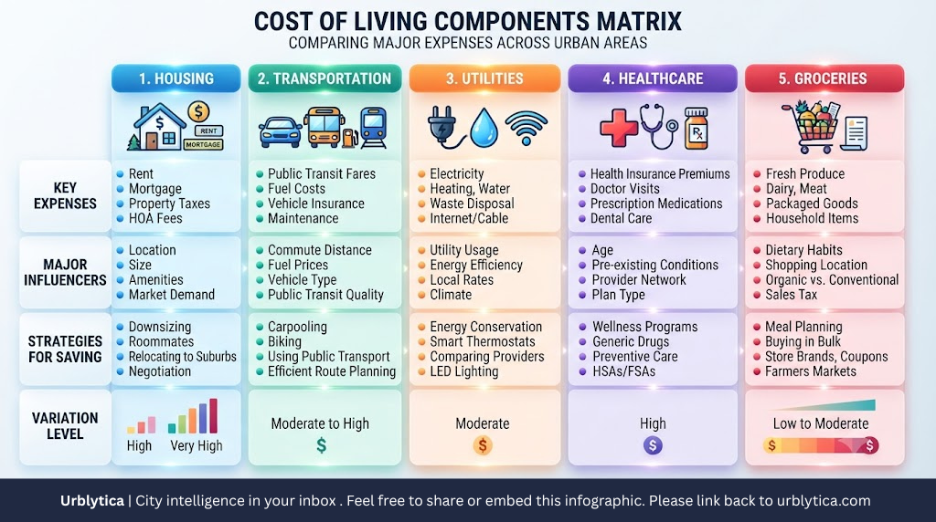
The cost of living is the most immediate concern for any individual or family considering a move to these cities. Austin has witnessedrapid escalation in housing costs due to the physical limitations of its geography and the intense demand for housing in its central urban core. Dallas, due to its ability to sprawl and expand its suburbs, has managed to maintain a more diverse housing stock that caters to different income brackets. Utilizing a cost of living calculator is the most effective way for professionals to gauge whether their current salary will cover their lifestyle expectations in either city.
For those considering the logistical hurdles of moving, calculating the relocation cost calculator is a necessary step in the decisionmaking process. The cost of living disparity is not just about rent or mortgage payments; it is also about the cost of transportation, utilities, and services. Dallas allows for a broader range of housing types, from highdensity urban apartments to spacious suburban detached homes. Austin is becoming increasingly defined by highend vertical living and luxury residential developments in the neighborhoods surrounding its downtown area.
Managing personal finance in these cities requires a disciplined approach. Many residents use a salary calculator to determine their net pay after taxes and costofliving adjustments, especially when moving between different markets in Texas. The ability to compare housing markets effectively is what separates those who thrive in these cities from those who find themselves stretched thin by their housing commitments.
Infrastructure and Regional Connectivity
In terms of infrastructure, Dallas is the clear winner for companies whose operations depend on global trade and regional distribution. Its international airport and freeway network are designed to handle massive volumes of traffic and freight. Companies that need to bulk address cleaner and manage complex distribution databases find that the logistical foundation of Dallas is unmatched in the southern United States.
Austin is currently undergoing a massive transformation in its transit systems. The city is attempting to connect its growing sprawl with light rail and expanded bus networks, but it remains a work in progress. For project managers, the ability to optimize daily calendar scheduling is critical in Austin because of the inevitable congestion that accompanies a booming city that is still perfecting its traffic management.
|
Feature |
Dallas Infrastructure |
Austin Infrastructure |
Impact Level |
|
Airport Capacity |
Massive |
Moderate |
High |
|
Freeway Density |
Very High |
Moderate |
High |
|
Public Transit |
Developing |
Expanding |
Moderate |
|
Logistics Flow |
Excellent |
Average |
Very High |
|
Fiber Connectivity |
High |
High |
High |
|
Urban Transit Access |
Moderate |
Developing |
Moderate |
|
Green Space Integration |
High |
High |
High |
|
Data Center Access |
Very High |
High |
High |
|
Regional Highway Miles |
High |
Moderate |
High |
|
Power Grid Reliability |
High |
High |
High |
This table outlines why Dallas continues to be the preferred destination for firms that rely on constant, reliable transit corridors. Austin is quickly catching up, but the infrastructure in Dallas is a legacy project that has been decades in the making and provides a substantial buffer for businesses.
Business Formation and Entrepreneurship
The entrepreneurial spirit in Texas is perhaps best represented by the competition between these two cities to be the best place to start a business. Austin is frequently featured on lists of the best cities for startups because of the sheer density of venture capital and the collaborative spirit of its business community. Dallas, however, offers a different kind of opportunity. It is a city of corporate partnerships. An entrepreneur who wants to build a business that serves enterprise clients will find a much more hospitable environment in Dallas.
When one decides to business formation, the regulatory environment in both cities is identical because both operate under state law, but the local ecosystem is what determines longterm viability. For those looking to buy a business, Dallas has a significantly larger and more mature market of established entities compared to the newer, more techheavy market in Austin.
Founders often use a breakeven calculator to map out their financial path, especially when dealing with the higher operational costs of a rapidly scaling city like Austin. In Dallas, the focus is often on optimizing existing workflows and leveraging established client relationships.
|
Business Metric |
Dallas Performance |
Austin Performance |
|
Startup Survival Rate |
85% |
82% |
|
Venture Capital Inflow |
High |
Very High |
|
Regulatory Ease |
High |
Moderate |
|
Access to Talent Pool |
High |
Moderate |
|
Office Space Availability |
High |
Low |
|
Business Networking |
High |
High |
|
Tax Benefits |
Yes |
Yes |
|
Growth Potential |
Steady |
Explosive |
|
B2B Market Density |
Very High |
Moderate |
|
Professional Support Services |
High |
High |
The success of a business in these cities often comes down to the alignment between the business model and the local economy. A retail franchise or service business that needs a large, stable customer base finds a home in Dallas. A software company that needs to recruit a highly specialized, young engineering talent pool usually finds Austin to be the superior choice. Many entrepreneurs also consult business guides to navigate the complexities of launching their new venture.
Workforce and Talent Dynamics
The workforce in Dallas is defined by its maturity. It is a pool of talent that includes everyone from seasoned banking professionals to experienced supply chain managers. The city educational institutions are heavily focused on producing the talent required for these established industries. Austin talent is more fluid. It is heavily composed of recent graduates and individuals who have relocated from other tech hubs in the country. This creates a workforce that is eager to innovate but perhaps less tied to the longterm institutional goals of a company compared to the Dallas workforce.
For firms planning to expand, accessing best cities for business research is the best way to understand which of these two pools is more appropriate for their specific organizational culture. The ability to find and retain talent is perhaps the most significant cost factor for businesses in 2026. Dallas offers a sense of stability that allows for longterm retention strategies, while Austin offers a sense of excitement that allows for rapid talent recruitment.
When preparing new hires, organizations must be careful to keep their data clean. Using a text redactor can help firms manage personal information securely during the hiring process. This is especially true in the competitive professional services market, where data privacy is a key differentiator for toptier firms.
Operational Efficiency and Data Management
Operational efficiency is the secret to thriving in a highcost environment. Companies operating in either city must focus on their internal workflows to minimize overhead. For those who are concerned about administrative costs, tools that allow you to manage your subscription analyzer spending are becoming industry standards. When you are operating in a market with high growth, it is easy to let your expenses drift. A disciplined approach to operational management can be the difference between a successful venture and one that fails to scale.
Furthermore, companies that focus on digital transformation often find that they can operate from anywhere in the state, but they choose to locate Dallas or Austin for the culture and the network. Using digital tools to calculate your business finances is a fundamental practice that entrepreneurs in both cities should follow to ensure that their expansion plans remain rooted in fiscal reality.
Healthcare and Senior Support Systems
Both cities are significant hubs for healthcare, but they occupy different niches. Dallas has massive, established healthcare systems that provide specialized care to a huge population. Austin is the center of a healthtech movement that focuses on integrating technology into patient experience. For those who need to research senior care options using city directories, both cities offer a variety of choices.
For families who are managing the aging process of their loved ones, finding reliable information is paramount. Whether you are looking for assisted living support coordination or need to understand the complexities of legal planning, both cities are equipped with the infrastructure to provide highquality care. The demographic shifts in 2026 indicate that the senior population is growing in both cities, and the healthcare sector is responding with increased investment.
Families often need to evaluate their options carefully. There is a lot of information available on how to manage longterm care for aging parents, and both Dallas and Austin have robust networks of professionals who specialize in this field.
|
Healthcare Metric |
Dallas Coverage |
Austin Coverage |
|
Specialist Availability |
High |
Moderate |
|
Research Facilities |
High |
High |
|
Senior Living Options |
High |
Moderate |
|
Emergency Services |
High |
High |
|
Cost of Care |
Competitive |
Rising |
|
Tech Integration |
Moderate |
High |
|
Accessibility |
High |
Moderate |
|
Future Expansion |
High |
Very High |
|
Insurance Network Density |
High |
Moderate |
|
Home Health Services |
High |
High |
As the population continues to age, the ability to find senior care resources will become a defining feature of the quality of life in both Dallas and Austin. Businesses that focus on the senior economy will find that both markets are ripe for investment.
Outlook for Texas Markets
The future for both Dallas and Austin is bright. Texas is benefiting from a trend where businesses are moving away from coastal markets and toward regions that offer a lower cost of living and a more probusiness regulatory climate. Dallas and Austin are the two most prominent faces of this movement. By 2026, we expect to see even more diversification in both economies. Dallas is becoming more techforward, and Austin is becoming more corporatefocused. This convergence will likely make the choice between the two even more difficult in the years to come.
The key to success for any entity looking at these markets is to stop viewing them as mutually exclusive. Both are part of a larger Texas growth engine. If a company has the resources, it may eventually find that it needs a presence in both cities to capture the full spectrum of the market. Dallas provides the reach, and Austin provides the innovation.
Frequently Asked Questions
1. Which city is better for earlystage tech startups?
Austin is typically favored for earlystage tech startups due to its intense culture of innovation and its massive influx of venture capital, although Dallas is growing rapidly in this space.
2. How do the demographics of Dallas and Austin influence local business strategy?
Dallas attracts a diverse and established workforce suitable for large corporate operations, whereas Austin draws a younger, techfocused demographic that is highly suited to agile and innovative projects.
3. Is it more expensive to live in Austin compared to Dallas?
Generally, yes. Austin has experienced a significant rise in housing costs because of its limited geographic expansion, whereas Dallas has a more elastic housing market with more suburban inventory.
4. What is the business tax climate like in these cities?
Both cities benefit from the Texas statewide advantage of having no individual income tax, which acts as a powerful incentive for both business owners and highincome employees to relocate.
5. How do I decide where to incorporate my businessin Texas?
Choose based on your specific industry needs. If your business requires deep industrial infrastructure and a mature talent pool, Dallas is excellent. If you need to stay on the bleeding edge of tech, Austin is the better fit.
6. What are the primary industries in Dallas?
Dallas is driven by a powerful mix of finance, telecommunications, insurance, logistics, and largescale professional services, making it a cornerstone for established corporate growth.
7. What are the primary industries in Austin?
Austin is the leader in software, hardware development, creative services, and an emerging healthtech sector that is rapidly gaining regional importance.
8. How can I find professional help to launch a business in either of these cities?
Entrepreneurs can utilize professional business guides and local chamber networks to ensure their business formation process is fully compliant and optimized for growth.
9. How does the commute time compare between the two regions?
Dallas is a commuter hub connected by an extensive freeway system. Austin is currently struggling with traffic congestion as its rapid population growth has outpaced the development of its transit infrastructure.
10. Are both cities suitable for retirees looking for longterm care?
Both cities provide excellent medical infrastructure. Dallas offers a higher density of largescale medical centers, while Austin is increasingly recognized for its focus on integrated, technologydriven healthcare solutions.

