Top Cities by Workforce Quality: A 2026 Economic Evaluation


Top Cities by Workforce Quality: A 2026 Economic Evaluation
Workforce quality, not cost, now drives business expansion decisions. Cities excelling in talent density, institutional agility, and technological integration are attracting significant investment. Regions with strong industry-education partnerships and proactive infrastructure development are leading economic growth.
The structural landscape of the American economy is undergoing a permanent transformation. As we navigate the complexities of 2026, corporate leadership teams no longer rely on simple costminimization models for geographic expansion. Instead, site selection is dictated by complex frameworks of institutional agility, technological integration, and talent density. Workforce quality has emerged as the definitive competitive differentiator for metropolitan areas across the United States. When organizations look to start a business or expand their footprint, the local labor ecosystem is the single most critical asset they evaluate.
The Modern Talent Ecosystem
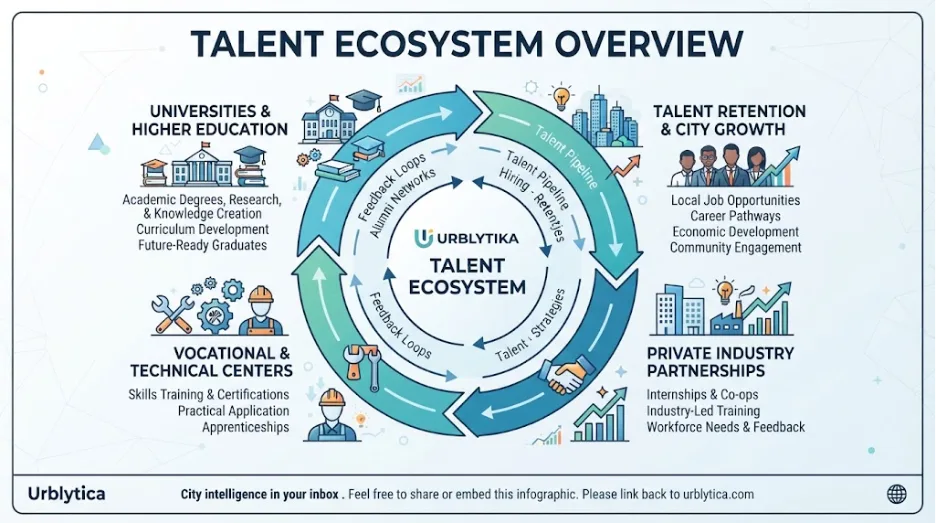
In previous decades, corporate site selection was often driven by historical inertia or low operational overhead. Today, executive teams prioritize regions that cultivate specialized labor pipelines. When evaluating where to scale operations, business leaders examine metrics provided by top resources such as insights and economic analysis to determine whether a region possesses the technical depth required for modern scaling. Cities that foster robust educational partnerships and continuous professional training are consistently outperforming traditional industrial hubs, attracting billions in capital investment.
Labor market elasticity refers to a region's ability to adjust to shifting workforce demands without causing inflationary pressure on wages. The most successful metropolitan areas have cultivated deep, systematic partnerships between private industry and higher education institutions. This collaboration ensures a steady stream of graduates equipped with the exact technical certifications and digital literacy required in fields ranging from advanced manufacturing to artificial intelligence integration. Furthermore, organizations frequentlyutilize tools like a salary calculator to stay competitive in these highgrowth environments while managing their total cost of labor effectively.
To ensure longterm stability when entering these markets, firms often evaluate the best cities for business to gauge where local municipalities are actively investing in infrastructure and workforce training. This proactive approach minimizes hiring risks and reduces timetofill metrics for crucial engineering and management roles.
Regional Performance Metrics and Economic Clustering
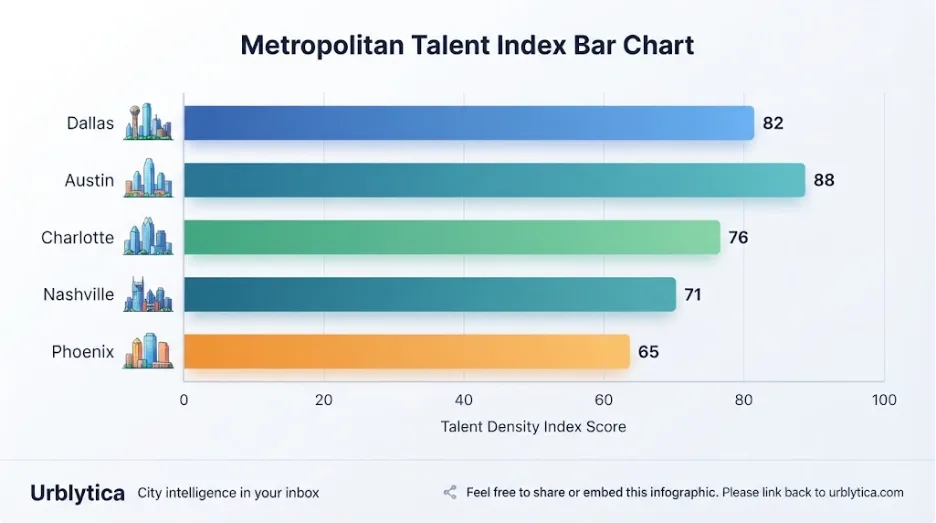
The Sunbelt and select secondary markets in the Midwest have solidified their positions as primary engines of human capital development. By analyzing regional economic growth, it becomes evident that regional clustering is the new standard for success. These regions are maturing as centers for innovation, aerospace engineering, and software development, providing an environment where talent can easily transition between emerging tech firms and established corporate headquarters.
|
Metropolitan Area |
Talent Density Index |
Institutional Readiness |
Primary Industry Focus |
|
Dallas |
9.4 |
Excellent |
Logistics and Tech |
|
Austin |
9.2 |
Strong |
Software and Semiconductors |
|
Charlotte |
8.9 |
Robust |
Financial Services |
|
Nashville |
8.7 |
Stable |
Healthcare and Music Tech |
|
Phoenix |
8.5 |
Growing |
Advanced Manufacturing |
For firms planning to start an LLC online, understand the distinct regional regulatory environments is critical. A city might possess a strong workforce, but if the compliance environment is cumbersome, the administrative burden can stifle output. This is why firms maintain a strict compliance calendar to ensure that their entity status remains in good standing across state lines. The failure to manage these details is often the primary reason why firms struggle when they attempt to expand into new, highpotential metropolitan areas.
Additionally, checking out resources like top states for business can provide valuable comparative insights into statelevel tax policies, corporate filing fees, and worker protection statutes that impact daily operations.
Capital Intensity and Modern Financial Analytics
Capitalintensive operations require a multidecade horizon for site selection. Leaders must look past immediate tax breaks to assess the longterm viability of energy grids, logistics networks, and technical training pipelines. As firms explore regional options, they must reconcile their internal financial models with the external realities of the local market. For instance, high labor costs in traditional hubs are often offset by the density of specialized engineering talent, whereas secondary cities may offer lower costs but require more investment in workforce development.
The complexity of due diligence has increased as firms scale. It is not sufficient to evaluate the financial health of the target enterprise alone. One must also model the external economic pressures of the city itself. Firms must monitor their breakeven point constantly as they account for varying utility costs and labor market pressures. Maintaining this financial discipline requires modern financial analytics suites to ensure that capital is always being deployed in highreturn assets.
When managing multistate payrolls and asset tracking, firms should also consider implementing a bulk address cleaner to maintain pristine data hygiene and avoid costly compliance penalties or state tax miscalculations.
The Human Element: Talent Acquisition and Retention
The final, and perhaps most important, piece of the workforce quality puzzle is the talent itself. As firms continue to shift toward highskill industries, the ability to recruit is synonymous with the ability to grow. Cities that have successfully branded themselves as desirable places to live and work are winning the war for talent. This involves not just competitive salaries, but a vibrant social and cultural scene that appeals to the modern workforce.
Using a relocation cost calculator allows firms to understand the financial reality their employees face when moving to a new region. This level of empathy in the recruitment process helps in securing longterm loyalty from employees who are otherwise bombarded with offers from competitors. When firms view their expansion through the lens of employee wellbeing, they achieve higher retention rates and, consequently, higher productivity across their entire organization.
Entrepreneurs and site selection managers can also explore insights on cities with strongest economic growth to discover emerging urban nodes where talent pools are expanding faster than costofliving pressures can erode them.
Frequently Asked Questions
-
What defines high workforce quality in 2026?
High workforce quality is characterized by specialized technical training, digital literacy, adaptability, and strong institutional partnerships between industry and education.
-
Why are secondary cities outperforming major hubs in labor retention?
Secondary cities often offer lower costs of living, reduced commuting friction, and targeted vocational programs that align directly with employer requirements.
-
How do firms evaluate potential talent pools before expanding?
Executives utilize comprehensive economic profiles, salary benchmarks, and demographic studies to assess the longterm sustainability of regional labor pools.
-
What role do universities play in regional talent development?
Universities act as anchor institutions, supplying continuous streams of skilled graduates and collaborating on research and development initiatives.
-
How can firms maintain compliance across multiple state labor markets?
Firms utilize dedicated compliance calendars and automated tracking tools to ensure adherence to multistate labor laws and corporate reporting standards.
-
What role does technology play in modern talent assessment?
Technology enables realtime analysis of demographic shifts, labor market elasticity, and wage pressures, empowering datadriven site selection.
-
How do firms calculate the return on investment for workforce training?
Firms analyze productivity gains, reduction in turnover rates, and longterm asset performance to validate capital spent on regional workforce development.
-
What is the impact of vocational partnerships on regional business climates?
Vocational partnerships create a steady supply of skilled technicians, significantly reducing hiring risks and timetofill metrics for expanding enterprises.
-
Why is data hygiene essential when expanding into new talent markets?
Inaccurate payroll, tax, or employee records can cause severe administrative bottlenecks and legal complications during multistate expansion.
-
How does the Sunbelt demographic shift affect workforce availability?
The continuous population influx into the Sunbelt provides a younger, highly dynamic labor pool, driving sustained economic growth across southern markets.